
3
In this activity, gold nanoparticles are synthesized from aqueous solutions of two starting reagents: gold (III) chloride (AuCl3), and sodium citrate (C6H5Na3O7).
The synthesis method is adapted from the gold nanoparticle demonstration kit developed by Ward’s Science (Catalog # 470336-160) as a scaled-down version. The commercial kit includes a more complete discussion of the demonstration and an additional activity utilizing the synthesized gold nanoparticles.
It is recommended to synthesize several batches of the gold nanoparticles, enabling observation and dicussion of batch-to-batch variability in the color of the synthesized nanoparticles. The nanoparticles synthesized in this activity are further utilized and compared to purchased gold nanoparticles in subsequent laboratories. The example photos and discussion questions presented here, along with example data provided in the laboratories, may not apply to observations in other laboratories or synthesis of gold nanoparticles using other methods or sources of starting materials.
Materials
- Deionized (DI) water
- Gold(III) chloride (AuCl3), 1 mM solution in dilute HCl
- Sodium citrate, 1 wt% (10 g/L) solution in deionized (DI) water
Citric acid is a weak acid compound that undergoes the following three deprotonation steps as pH increases across each pKa (Figure A1.1):
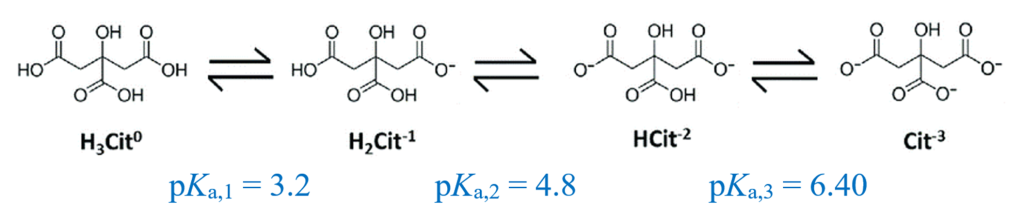
Interpreting pKa values: pKa is defined as the log (base 10) of the acid dissociation constant for a weak acid. For compounds with multiple weak acid or weak base functional groups, an individual pKa value (i.e., pKa,1, pKa,2, etc.) is assigned for each sequential deprotonation step. Hence, citric acid has three pKa values representing dissociation of each of the three carboxylic acid (-COOH) functional groups. When the pH of the solution is equal to the pKa value, there are equivalent activities (i.e., molar concentrations for ideal solutions) of the protonated and deprotonated form. Below the pKa value, the functional group will be predominantly in the protonated form; above the pKa value, the functional group will be predominantly in the deprotonated form. This concept will become important in later chapters related to surface charge.
The original version of this chapter contained H5P content. You may want to remove or replace this element.
Initial observations
Report your initial observations of the color and optical transparency (i.e., clearness vs. cloudiness) of the two starting solutions:
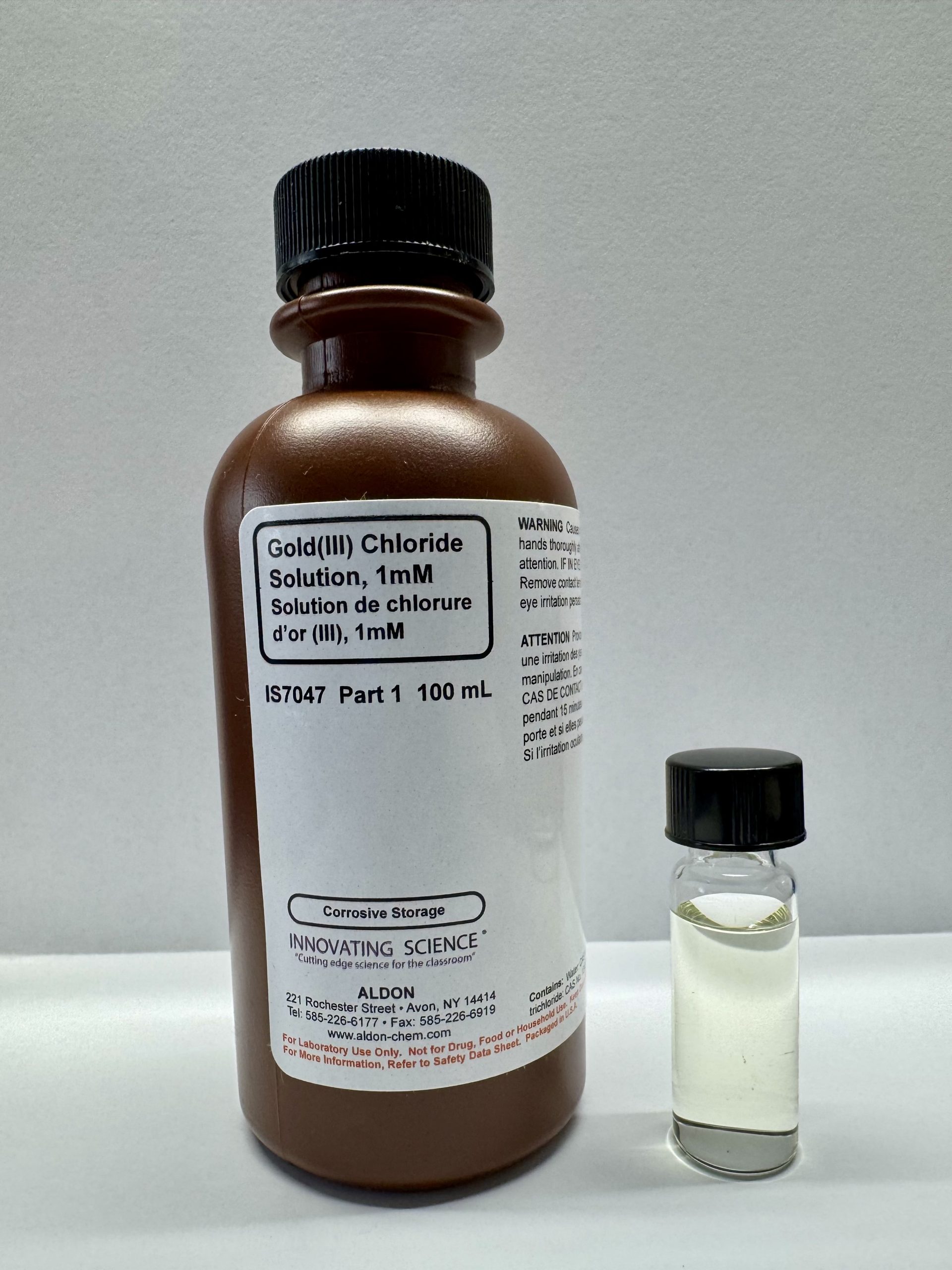
- Appearance of the gold (III) chloride solution:
Expected observations (click to reveal):
The dissolved gold (III) chloride yields a pale yellow, optically transparent solution (Figure A1.2).
- Appearance of the sodium citrate solution:
Expected observations (click to reveal):
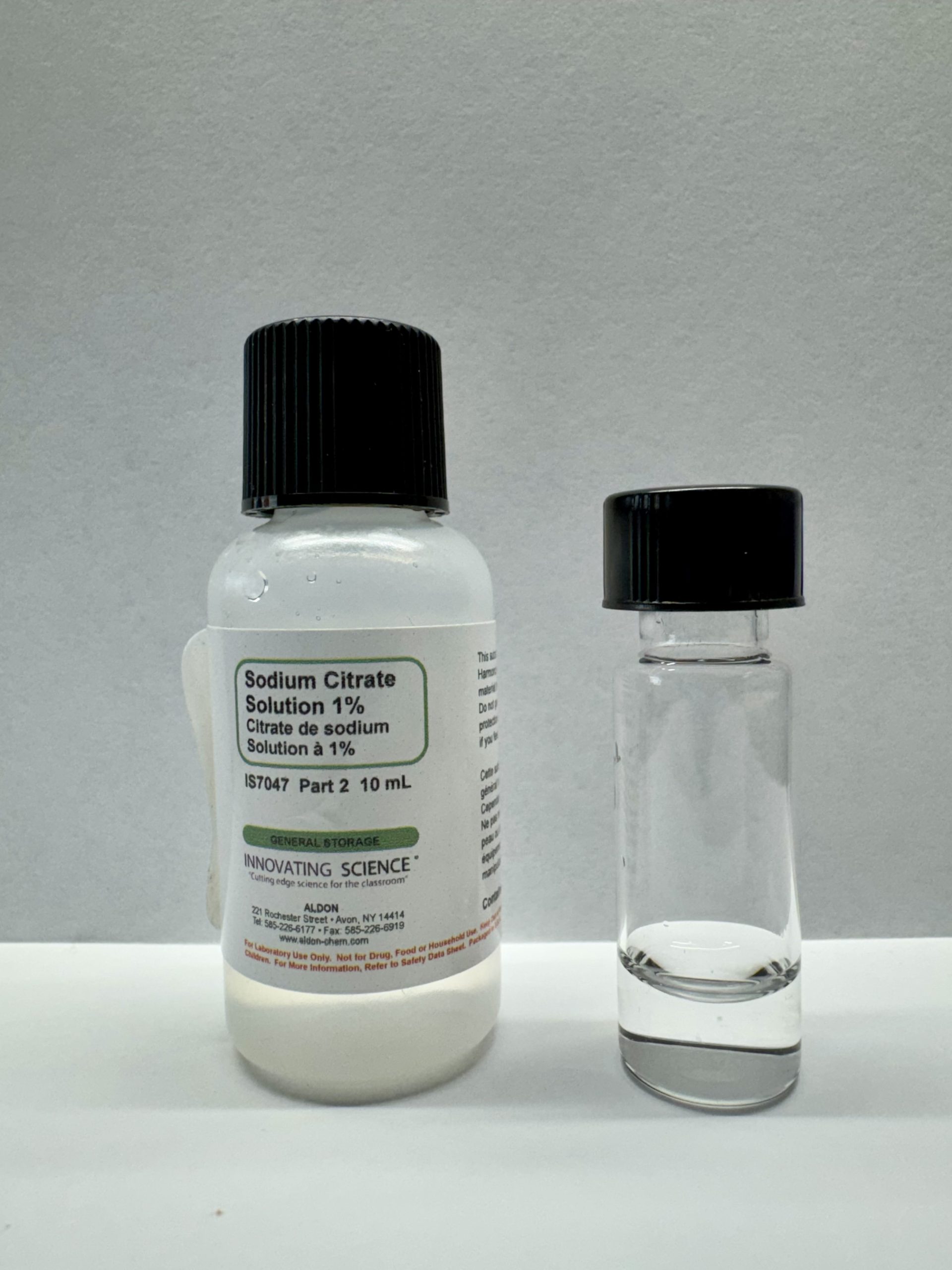
The sodium citrate solution yields a colorless, optically transparent solution (Figure A1.3).

Figure A1.3. Sodium citrate solution.
Nanoparticle synthesis procedure
- Add 9 mL of DI water and a stirbar to a glass scintillation vial.
- Add 1 mL of the gold (IIII) chloride solution. Heat with stirring until the solution comes to a boil.
- Add 0.1 mL of the sodium citrate solution. Heat for another 10 minutes.
- Cool the sample before handling.
Observations after the synthesis reaction
Report your observations of the color and optical transparency of the heated gold chloride solutions (before sodium citrate addition) and the synthesized gold nanoparticles (after sodium citrate addition).
- Appearance of the synthesized gold nanoparticles:
Expected observations (click to reveal):
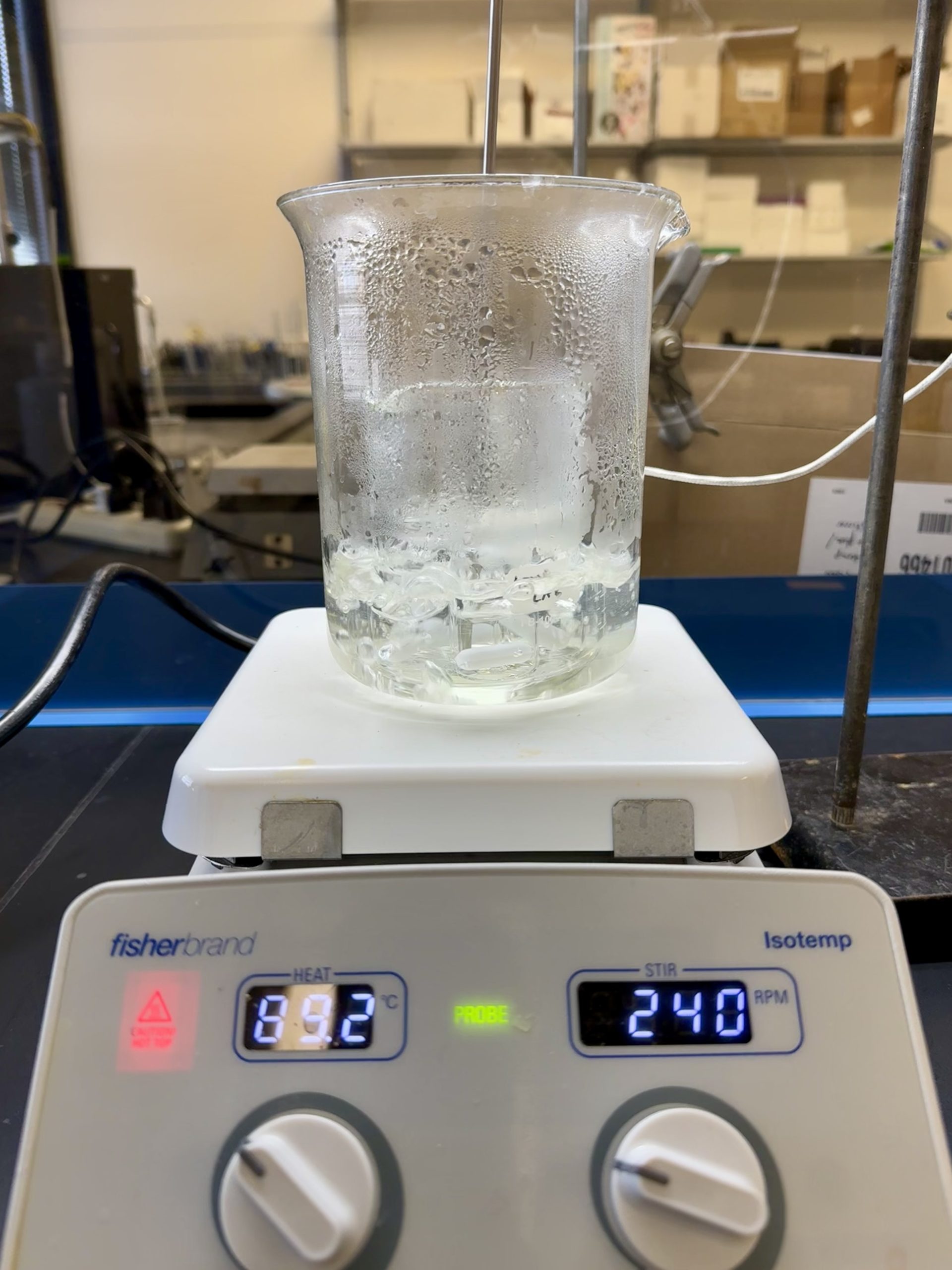
The heated solution of gold chloride should still appear transparent (Figure A1.4):
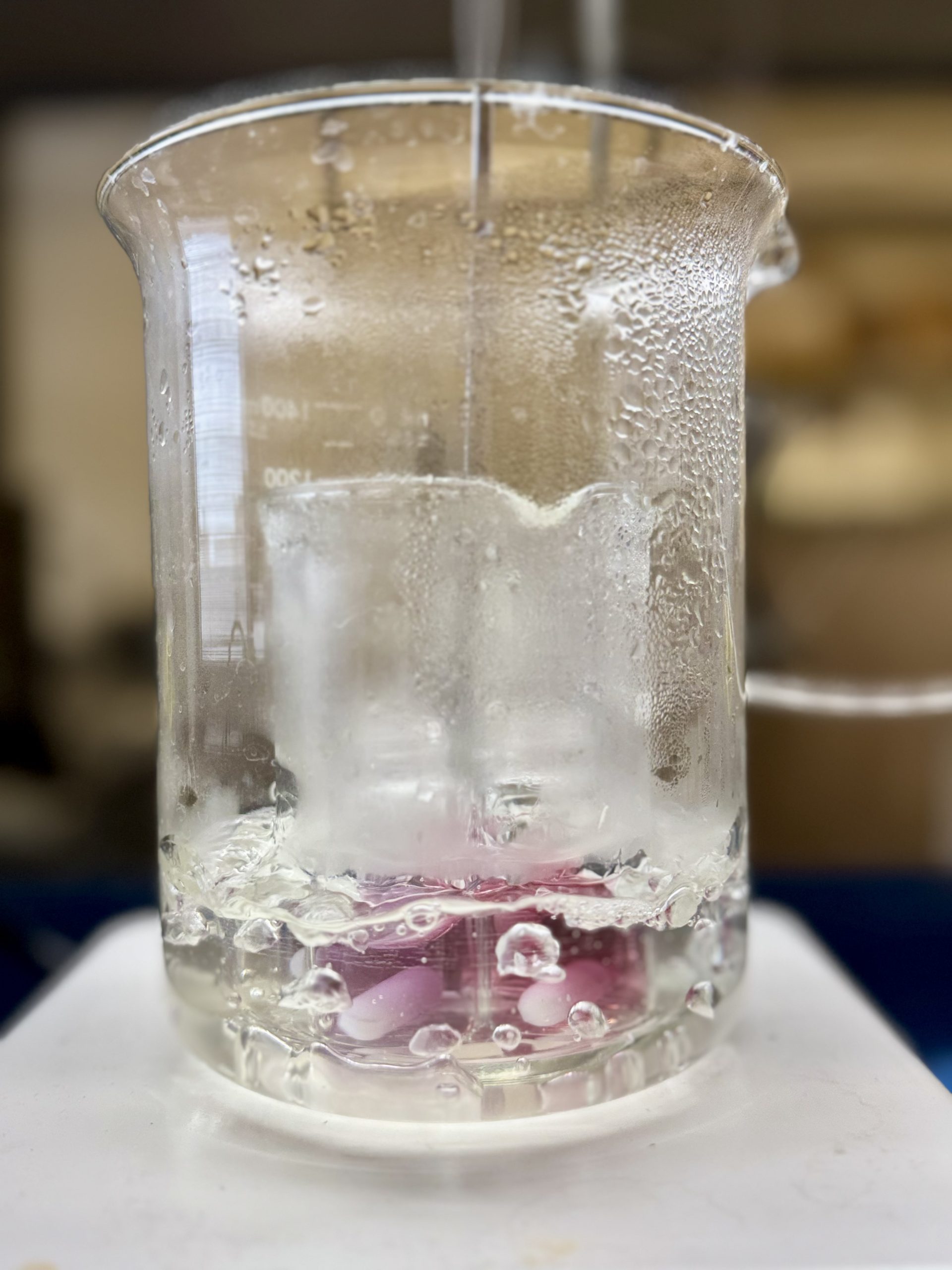
Figure A1.4. Heated gold chloride solutions, before sodium citrate addition. After adding the citrate solution, the suspension of synthesized gold nanoparticles will optimally have a red color (recall the application of gold nanoparticles in the COVID test assay shown in Chapter 1). However, the sample will still appear optically transparent to the naked eye (i.e., not cloudy or opaque) because of the very small size of the nanoparticles.
Figure A1.5. Gold nanoparticles being synthesized after citrate addition.
Variability in the synthesis reaction
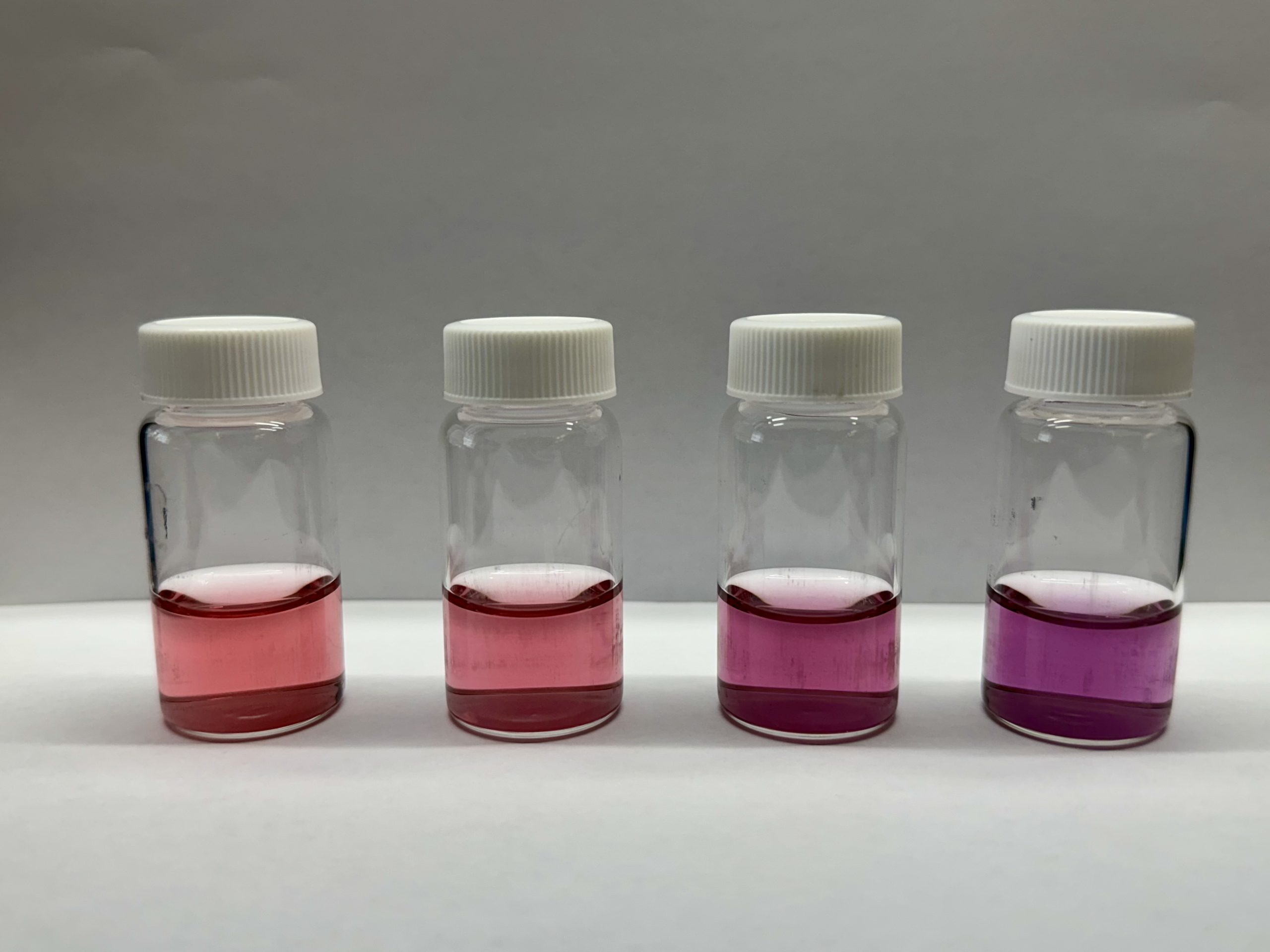
Try synthesizing several batches of gold nanoparticles. Compare the colors of all the samples to comment on the consistency or variability across the different batches.
- Observed variability across multiple batches of gold nanoparticles:
Observations in our laboratory (click to reveal):
For nanoparticles synthesized in our laboratory using the adapted test kit method described above, we observe variability in different batches, with some showing pale red or pink colors, whereas others show purple colors. The degree of consistency may differ with other laboratories, synthesis methods, or starting materials.

Figure A1.6. Variability in the colors of four batches of gold nanoparticle samples, all synthesized at the same time. - Which nanoparticle properties do you think might vary between the differently-colored batches of gold nanoparticles?
Common responses (click to reveal):
Any of several features from the list of key properties in Chapter 1 could potentially result in the different colors, including particle size, particle shape, surface charge, and/or agglomeration state. However, it is not possible to identify the exact reason for the differences in color simply by looking at the sample. This issue motivates the need to perform one or more measurements that could be used to deduce which of these properties may differ between the samples. These two samples will be revisited in the subsequent laboratories.
Brief discussion of the synthesis reaction
In the initial solution of gold (III) chloride, the gold is initially in the +3 oxidation state. The addition of the sodium citrate serves two roles. First, the citrate acts as a reducing agent to reduce gold to an oxidation state of 0 and induce precipitation of the dissolved gold (III) to form gold (0) nanoparticles. Secondly, the citrate molecules adsorb to the surface of the gold nanoparticles. As depicted above, citrate has three carboxylic acid groups that can deprotonate to carboxylates (-COO–). The negatively charged citrate imparts an overall negative charge to the gold nanoparticles. These charges induce repulsion between the nanoparticles, resulting in a colloidally stable (non-agglomerating) suspension of individually dispersed gold nanoparticles. The type of nanoparticles synthesized here is hence frequently denoted as “citrate-stabilized gold nanoparticles.” Charge repulsion and colloidal stability will be covered in further detail in subsequent chapters, as well as in Activity 2.