
8
The discussion on surface charge and potential (Chapter 5) and interaction energy profiles (Chapter 6) is concluded here in Chapter 7 with discussion on how these factors impact the colloidal stability and rate of agglomeration for particles in suspnsion, followed by Activity 2 where these concepts are demonstrated using real samples of gold nanoparticles and TiO2 nanoparticles.
7.1 Chemical reaction theory
Exercise 7.1: Cookies🍪
Figure 2.1 shows common ingredients used to make chocolate chip cookies on the left, and cookies on the right.
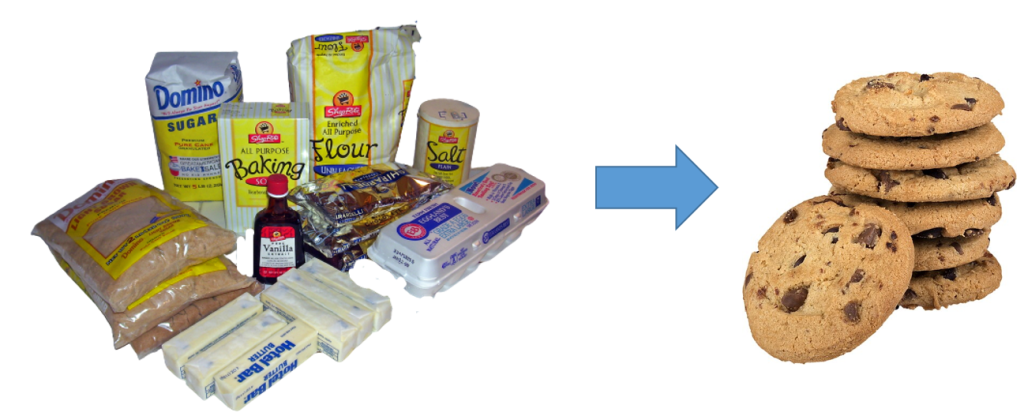
List the major steps needed the get from the ingredients on the left to the cookies on the right.
Why did we do this? At this moment, you may be more familiar with chemical reaction theory (including real-world applications such as baking) than particle attachment theory. The two situations are analogous, so a refresher on chemical reactions is provided before discussing particle attachment.
In the exercise above, your list should hopefully include (1) mixing the ingredients and (2) baking them in the oven. Analogously, for elementary chemical reactions in which two species, A and B, react directly to form one or more reaction products, P, (1) physical contact must occur between the two species, and (2) if there is an activation energy barrier to the reaction (i.e., it is not spontaneous), energy is required, e.g. in the form of heat. For example, the Maillard reaction that results in browning of food (e.g. cookies in the oven or meat on a grill) involves a reaction between amino acids and sugars at high heat.
Equation 7.1 provides a reaction equation wherein [latex]a[/latex] molecules of species A react irreversibly with [latex]b[/latex] molecules of species B to form [latex]p[/latex] molecules of product P:
| [latex]a\text{A}+b\text{B}\to p\text{P}[/latex] | Irreversible reaction equation (7.1) |
The higher the rate of molecular interactions between the reactants (and hence, the higher the molar concentrations of the reactants, [latex]C_{\text{A}}[/latex] and [latex]C_{\text{B}}[/latex]), the faster the reaction will occur. This concept is encapsulated in the elementary rate law expression, where the reaction rate (e.g., the rate of loss of reactant A [latex]r_{\text{A}}[/latex]) depends on the reactant concentrations following Equation 7.2:
| [latex]{{r}_{\text{P}}}=-{{r}_{\text{A}}}=-kC_{\text{A}}^{a}C_{\text{B}}^{b}[/latex] | Elementary rate law expression (7.2) |
where [latex]k[/latex] is the rate constant for the reaction (whose units depend on the stoichiometric coefficients, [latex]a[/latex] and [latex]b[/latex]), and the negative sign indicates loss of reactant A over time.
The rate of reaction further also increases with higher energy input, e.g. higher temperature. This dependence is expressed in the Arrhenius equation (Equation 7.3):
| [latex]k=A{{e}^{-\frac{{{E}_{\text{A}}}}{\left( RT \right)}}}[/latex] | Elementary rate law expression (7.3) |
7.2 Particle attachment theory
Just as with the chemical reactions described above, particle attachment requires (1) a collision between the particle and another particle or surface, and (2) if an energy barrier is present in the interaction energy profile (Chapter 6), the particle must have sufficient energy to overcome the barrier an attach.
7.2.1 Fast (diffusion-limited) attachment
In the absence of any energy barrier, the particle attachment rate is equal to the particle collision rate. This scenario is termed “fast” or “diffusion-limited” attachment.
The collision rate is represented in the Smoluchowski coagulation rate equation as a population balance tracking the loss in the number concentration of individual (non-agglomerated) spherical particles of species “1” over time, [latex]{N}_{1}[/latex], upon colliding and forming agglomerates with spherical particles of species “2” (Equation 7.4):
| [latex]\frac{d{{N}_{1}}}{dt}=-4\pi \left( {{R}_{\text{s},1}}+{{R}_{\text{s},2}} \right)\left( \frac{{{D}_{1}}+{{D}_{2}}}{2} \right){{N}_{1}}{{N}_{2}}[/latex] | Smoluchowski coagulation rate equation for collision of two different particles (7.4) |
where [latex]{{N}_{2}}[/latex] is the number concentration of particle “2;” [latex]{{R}_{\text{s},1}}[/latex] and [latex]{{R}_{\text{s},2}}[/latex] are the spherical radii of particles “1” and “2,” respectively; and [latex]{{D}_{1}}[/latex] and [latex]{{D}_{2}}[/latex] are the diffusion coefficients of particles “1” and “2,” respectively.
For homoaggregation of particle “1” with particles of the same type, the parameters for particle “1” are inputted for both “1” and “2” and the particle type does not need to be explicitly indicated via subscripts. That is, Equation 7.4 becomes Equation 7.5:
| [latex]\frac{dN}{dt}=-8\pi {{R}_{\text{s}}}D{{N}^{2}}=-\frac{4}{3}\frac{{{k}_{\text{B}}}T}{\eta }{{N}^{2}}[/latex] | Smoluchowski coagulation rate equation for homoaggregation of particles (7.5) |
where the expression on the right-hand-side is achieved by applying the Stokes-Einstein equation (Equation 4.6) for the diffusion coefficient of a spherical particle. The grouping of parameters that multiply onto the concentration dependence can further be taken as the rate constant for fast attachment, [latex]{k}_{\text{f}}[/latex] (Equation 7.6):
| [latex]{k}_{\text{f}}=\frac{4}{3}\frac{{{k}_{\text{B}}}T}{\eta}[/latex] | Rate constant for fast attachment (7.6) |
7.2.2 Slow (reaction-limited) attachment
Analogously to the reaction energy barrier in the Arrhenius equation, an energy barrier to attachment — such as electrostatic or steric repulsion — will result in a reduction in the attachment rate. This scenario is termed “slow” or “reaction-limited” attachment. The rate constant for slow attachment, [latex]{k}_{\text{s}}[/latex], is related to [latex]{k}_{\text{f}}[/latex] by Equation 7.7:
| [latex]{{k}_{\text{s}}}={{k}_{\text{f}}}{{e}^{-\frac{{{V}_{\text{m}}}}{{{k}_{\text{B}}}T}}}[/latex] | Rate constant for slow attachment (7.7) |
where [latex]{V}_{\text{m}}[/latex] is the height of the energy barrier to attachment, i.e., the maximum point on the DLVO or extended DLVO plots discussed in Chapter 6; [latex]{k}_{\text{B}}[/latex] is the Boltzmann constant; and [latex]T[/latex] is the temperature.
The ratio of the fast to slow attachment rate constants is denoted as the stability ratio, [latex]W[/latex] (Equation 7.8):
| [latex]W=\frac{{{k}_{\text{f}}}}{{{k}_{\text{s}}}}[/latex] | Stability ratio (7.8) |
Alternatively, the ratio of the slow to fast attachment rate constants, i.e., the inverse stability ratio, can be reported as the attachment efficiency, [latex]\alpha[/latex] (Equation 7.9), ranging from [latex]\alpha=0[/latex] for no attachment and [latex]\alpha=1[/latex] for fast attachment.
| [latex]\alpha =\frac{1}{W}=\frac{{{k}_{\text{s}}}}{{{k}_{\text{f}}}}[/latex] | Attachment efficiency (7.9) |
7.2.3 Critical coagulation concentration (CCC)
As discussed in the prior chapters, electrostatic interactions are screened by electrolytes in the medium separating two particles. Hence, repulsive energy barriers decline with increasing salt concentration, subsequently resulting in faster attachment rates and diminished colloidal stability. This effect is commonly represented in a stability plot, such as that in Figure 7.2, relating [latex]W[/latex] or [latex]\alpha[/latex] to the molar salt concentration, [latex]C[/latex]. When plotted on a log-log plot, the relationship is linear in the slow attachment regime at low to moderate electrolyte concentrations, until the fast attachment regime ([latex]W=1[/latex] or [latex]\alpha=1[/latex] is attacined at high electrolyte concentrations.
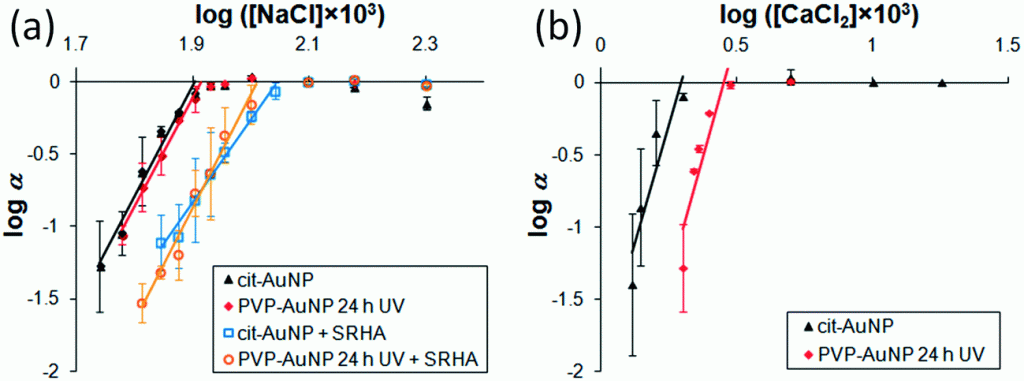
By definition, fast attachment occurs when there is no repulsive energy barrier, i.e., [latex]{{V}_{\text{m}}}=0[/latex]. By rule of thumb, slow attachment is observed when [latex]0<{{V}_{\text{m}}}<15{{k}_{\text{B}}}T[/latex], while negligible attachment is observed when [latex]{{V}_{\text{m}}}>15{{k}_{\text{B}}}T[/latex]. The latter [latex]15{{k}_{\text{B}}}T[/latex] threshold corresponds approximately to [latex]\log W>4[/latex].
Note on the relationship between attachment rates and agglomerate structure
At the end of Chapter 3, the fractal dimension was defined and related to agglomerate structure. The agglomerate structure that develops from particle attachment depends on the rate of attachment. Fast (diffusion-limited) attachment results in looser or more linear agglomerates having a fractal dimension closer to 1, whereas slow (reaction-limited) attachment results in denser or more compact/spherical agglomerates having a fractal dimension closer to 3.